Ohio Regulation 26991
- Adopted Partial Rule - June 20, 2024
- Adopted Partial Rule - June 10, 2024
- Adopted Partial Rule - May 31, 2024
- Refiled Filing - Changes Proposed - May 16, 2024
- Refiled Filing - Changes Proposed - May 9, 2024
- Refiled Filing - Changes Proposed - May 8, 2024
- Revised Filing - Changes Proposed - Apr 17, 2024
- Revised Filing - Changes Proposed - Apr 16, 2024
- Revised Filing - Changes Proposed - Mar 29, 2024
- Proposed Rule - Mar 26, 2024
PUBLIC HEARING NOTICE
PROVIDER CERTIFICATION: APPLICATION, REVIEW, DISCIPLINE
ODA proposes to amend rules 173-39-03, 173-39-04, and 173-39-05 of the Administrative Code. Please review the business impact analysis (BIA) for details.
ODA will conduct a public hearing on these rules at the following place, date, and time:
Place: Conference Room 452
Rhodes Tower, 4th Floor
30 E Broad St
Columbus, OH 43215
Date: April 30, 2024
Time: 10:00AM
Any person may participate in person or online.
If in person, please understand that the building's security staff will require any visitor to the building to register at the security desk by showing a government-issued photo identification (e.g., a driver's license), pass through a metal detector, and allow belongings to be inspected. Please arrive early enough to complete this registration process before the hearing begins. Participants may find area parking at street meters and area parking garages, including the Statehouse Underground Parking Garage.
If online, click here to join the meeting via Microsoft Teams.
Any person may email written testimony to rules@age.ohio.gov before the day of the hearing in lieu of presenting testimony at the hearing, whether in person or online.
Any person who testifies in person or online will receive a written response if the person also provides ODA with their name, email address, and a written version of their testimony before 5:00PM on the day of the hearing. A person may email this information to rules@age.ohio.gov.
Please email Helena Carter, ODA's ADA coordinator, at hcarter@age.ohio.gov no later than 7 business days before the hearing to request a reasonable accommodation due to a disability.
Please email Tom Simmons, ODA's policy development manager, at rules@age.ohio.gov with any other questions about this hearing.
173-3-01 Older Americans Act: introduction and definitions.
(A) Introduction: This chapter regulates AAA-provider agreements for services paid, in whole or in part, with Older Americans Act funds.
(B) Definitions for this chapter and Chapter 173-4 of the Administrative Code:
"AAA-provider agreement" (agreement) means a contract or grant between an AAA and a provider for the provision of services to consumers.
"Activities of daily living" (ADLs) means bathing; dressing; eating; grooming; toileting; transferring in and out of a bed or chair; and walking.
"Agency provider " means a provider hiring persons to provide services to consumers.
"Area agency on aging" (AAA) means an entity ODA designates to be an AAA under rule 173-2-04 of the Administrative Code.
"Assessment" means a gathering of information about a person's strengths, problems, financial resources, and care needs in the following major functional areas: physical health, use of medical care, ADLs, IADLs, mental and social functioning, physical environment, and use of services and supports.
"Assistance with self-administration of medication" has the same meaning as in paragraph (C) of rule 4723-13-02 of the Administrative Code when an unlicensed person provides the assistance.
"Business day" means any day that is not a Saturday, Sunday, or legal holiday in section 1.14 of the Revised Code.
"Care-coordination program" means a program coordinating and monitoring the provision of services.
"Caregiver" and "family caregiver" have the same meaning as "family caregiver" in 42 U.S.C. 3022.
"Case management service" has the same meaning as in 42 U.S.C. 3002.
"Competency evaluation" includes both standardized testing (which may include written testing) and skills testing by return demonstration to ensure an applicant or employee is able to address the care needs of the consumer to be served.
"Consumer" means, for the purposes of services paid for, in whole or in part, with Older Americans Act funds, any person sixty years of age or older, unless a different age is required by a state or federal law.
"Contract" has the same meaning as "AAA-provider agreement," unless the context clearly indicates otherwise.
"Coordination" means the development and implementation of an integrated service delivery system to ensure appropriate care, service levels, and continuity for consumers. This includes integration with other federal, state, and local programs and services to promote synchronization of planning, policy development, priority setting, and evaluation of activities related to the objectives of the Older Americans Act without, to the extent possible, duplicating services and or compromising the consumer's goals and objectives.
"Day" means a twenty-four-hour period beginning and ending at midnight.
"Electronic record" has the same meaning as in section 1306.01 of the Revised Code. For a health care record, "electronic record" has the same meaning as in section 3701.75 of the Revised Code.
"Electronic signature" has the same meaning as in section 1306.01 of the Revised Code. If attached to, or associated with, a health care record, "electronic signature" has the same meaning as in section 3701.75 of the Revised Code.
"Health care record" has the same meaning as in section 3701.75 of the Revised Code. Examples of a health care record are a plan of treatment or diet order received from a licensed healthcare professional.
"Incident" means an event that is inconsistent with the routine care or routine provision of services to a consumer. An incident may involve a consumer, caregiver (to the extent it impacts a consumer), provider, provider's staff or facility, another facility, an AAA's staff, ODA's staff, or other administrative authorities. Examples of an incident are abuse, neglect, abandonment, an accident, or an unusual situation resulting in an injury to a person or damage to the person's property or equipment.
"Instrumental activities of daily living" (IADLs) means preparing meals, shopping for personal items, medication management, managing money, using the telephone, doing heavy housework, doing light housework, and the ability to get and use available transportation without assistance.
"Legal holiday" has the same meaning as in section 1.14 of the Revised Code.
"Licensed healthcare professional" includes a physician with an "expedited license," as defined in section 4731.11 of the Revised Code; or a licensed audiologist, occupational therapist, occupational therapy assistant, physical therapist, physical therapy assistant, or speech-language pathologist from another state with "compact privilege," as defined in section 4753.17, 4755.14, or 4755.57 of the Revised Code.
Beginning on January 1, 2023, "licensed
"Licensed healthcare professional" also includes an RN or LPN with a "multistate license" from another state with "multistate licensure privilege," as those terms are defined in section 4723.11 of the Revised Code.
"Licensed practical nurse" (LPN) has the same meaning as in divisions (E) and (F) of section 4723.01 of the Revised Code. Beginning on January 1, 2023, "licensed
"Licensed practical nurse" also includes a licensed practical nurse with a "multistate license" from another state with "multistate licensure privilege," as those terms are defined in section 4723.11 of the Revised Code.
"ODA" means the Ohio department of aging.
"Older Americans Act" means 42 U.S.C. Chapter 35.
"Older Americans Act funds" means the federal funds awarded to ODA through Title III of the Older Americans Act (42 U.S.C. Chapter 35, Subchapter III) and any state or local funds used to match those federal funds, regardless of whether the local funds are public or private funds. For the purposes of this chapter and Chapter 173-4 of the Administrative Code, "Older Americans Act funds" does not mean funds for an ombudsman program.
"Older relative caregiver" has the same meaning as in 42 U.S.C. 3030s.
"Participant-directed provider " means a provider (e.g., relative, friend, neighbor, or other person) a consumer hired and directs to provide services to the consumer.
"PCA" means "personal care aide."
"Planning and service area" (PSA) means a geographic region of Ohio that ODA designated as a planning and service area under rule 173-2-02 of the Administrative Code.
"Provider" means a person or entity entering into an AAA-provider agreement with an AAA to provide services to consumers. The three categories of providers are agency providers, self-employed providers, and participant-directed providers.
"Agency provider" means a provider hiring persons to provide services to consumers. "Self-employed provider" means a provider who provides services to consumers and who does not hire, or contract with, other persons to provide those services. "Participant-directed provider" means a provider (e.g., relative, friend, neighbor, or other person) a consumer hired and directs to provide services to the consumer.
"Registered nurse" (RN) has the same meaning as in section 4723.01 of the Revised Code. Beginning on January 1, 2023, "registered
"Registered nurse" also includes a registered nurse with a "multistate license" from another state with "multistate licensure privilege," as those terms are defined in section 4723.11 of the Revised Code.
"RFP" means "request for proposal."
"Self-employed provider " means a provider who provides services to consumers and who does not hire, or contract with, other persons to provide those services.
"Unique identifier" means an item belonging to a specific consumer, caregiver, provider (in the case of rules 173-3-06.2 and 173-3-06.3 of the Administrative Code), aide (in the case of rule 173-3-06.4 of the Administrative Code), PCA (in the case of rule 173-3-06.5 of the Administrative Code), driver (in the case of rules 173-3-06.6 and 173-4-05.2 of the Administrative Code), or instructor (in the case of rule 173-4-08 of the Administrative Code) that identifies only that consumer, caregiver, provider, aide, PCA, driver, or instructor. Examples of a unique identifier are a handwritten or electronic signature or initials, fingerprint, mark, stamp, password, barcode, or swipe card. A consumer, caregiver, provider, aide, PCA, driver or instructor offers their unique identifier as an attestation that a provider, or the provider's staff, completed an activity or unit of service or as an authorization for a plan or agreement.
Effective:
Five Year Review (FYR) Dates: 3/26/2024
_____________________
Certification
_____________________
Date
Promulgated Under: 119.03
Statutory Authority: 121.07, 173.01, 173.02, 173.392; 42 U.S.C. 3025; 45 C.F.R. 1321.9
Rule Amplifies: 173.39, 173.392; 42 U.S.C. 3002; 45 C.F.R. 1321.3, 1321.9
Prior Effective Dates: 02/19/2009, 06/01/2014, 08/01/2016, 02/01/2017, 05/08/2020, 12/31/2020, 01/29/2022, 01/01/2023
173-3-06.4 Older Americans Act: homemaker service.
(A) Definitions for this rule:
(1) "Homemaker service" (homemaker) means a service providing routine activities to help a consumer to achieve and maintain a clean, safe, and healthy living environment.
(a) "Homemaker service" includes the following activities:
(i) Routine meal-related activities: planning a meal, preparing a meal, and planning a grocery purchase.
(ii) Routine household activities: dusting furniture, sweeping, vacuuming, mopping floors, removing trash, and washing the inside of windows that are reachable from the floor, kitchen care (washing dishes, appliances, and counters), bedroom and bathroom care (changing bed linens and emptying and cleaning bedside commodes), and laundry care (washing, drying, folding, ironing, and putting the laundry away in the consumer's home and washing an drying at a laundromat if the consumer does not have a working washer an dryer).
(iii) Routine transportation activities: providing an errand outside of the presence of the consumer (e.g., picking up a prescription or groceries), or escort, but not transportation under rule 173-3-06.6 of the Administrative Code.
(iv) The activities described in paragraphs (A)(1)(a)(i) to (A)(1)(a)(iii) of this rule when they assist the consumer as respite to the consumer's caregiver or are essential to the health and safety of the consumer as respite to the consumer's caregiver.
(b) "Homemaker service" does not include the following activities:
(i) Activities provided outside of the home with the exception
exceptions of the laundry activities in paragraph (A)(1)(a)(iii) of this rule and the routine transportation activities listed in paragraph (A)(1)(a)(iii) of this rule.
(ii) Activities within the scope of home maintenance and chores.
(iii) Activities available through third-party insurers, community supports, Ohio medicaid state plan, or a medicaid waiver program.
(iv) Activities to administer or set-up medications.
(2) "Aide" means the person who provides homemaker activities.
(B) Requirements for every AAA-provider agreement with agency providers for homemaker activities paid, in whole or in part, with Older Americans Act funds:
(1) The AAA-provider agreement is subject to rule 173-3-06 of the Administrative Code.
(2) Licensure: The provider is subject to the requirement under Chapter 3740. of the Revised Code and Chapter 3701-60 of the Administrative Code for the provider to hold a current, valid license to provide skilled home health services or nonmedical home health services.
(3) Availability: The provider shall maintain the following:
(a) Adequate staffing levels to provide homemaker activities at least five days per week.
(b) A back-up plan for providing homemaker activities when the provider has no aide available.
(c) The availability of an aide supervisor during all hours when aides are scheduled to work.
(4) Aides:
(a) Initial qualifications: The provider may allow a person to serve as an aide only if the person meets at least one of the following qualifications and the provider meets the verification requirements under paragraph (B)(4) (e) of this rule:
(i) The person meets at least one of the qualifications to be a PCA under paragraph (B)(4)(a) of rule 173-3-06.5 of the Administrative Code.
(ii) The person successfully completed a training and competency evaluation program with the following characteristics:
on any activity listed under paragraph (A)(1)(a) of this rule that the person would provide as an aide. For example, a person who would provide only laundry activities as an aide would qualify to be an aide by successfully completing training and competency evaluation on laundry activities.
(a) The training lasted at least twenty hours.
(b) All the following subjects were included in the program's training and its competency evaluation:
(i) Communications skills, including the ability to read, write, and make brief and accurate reports (oral, written, or electronic).
(ii) Universal precautions for infection control, including hand washing and the disposal of bodily waste.
(iii) Homemaker activities.
(iv) Recognition of emergencies, knowledge of emergency procedures, and basic home safety.
(v) Record-keeping skills.
(b) Orientation: Before allowing aides or other employees to have direct, face- to-face contact with consumers, the provider shall provide the aides or other employees with orientation that, at a minimum, addresses the following topics:
(i) The provider's expectations of employees.
(ii) Person-centered care.
(iii)
(ii) The provider's ethical standards.
(iv)
(iii) An overview of the provider's personnel policies.
(v)
(iv) The organization and lines of communication of the provider's agency.
(v) Person-centered care.
(vi) Incident reporting.
(vii) Emergency procedures.
(viii) Standard precautions for infection control, including hand washing and the disposal of bodily waste.
(c) In-service training: The provider shall retain records to show that each aide successfully completes eight
six hours of ODA-acceptable in-service training every twelve months. Agency- and program-specific orientation do not count toward the eight
six hours. If the aide is also a PCA according to rule 173-3-06.5 of the Administrative Code, the provider may consider eight
six hours of successfully-completed ODA-acceptable in-service training as a PCA to count for the eight hours required as an aide by this paragraph.
(d) Training sources:
Acceptable training, orientation, and competency evaluation:
(i) An organization other than the provider may provide the orientation and training required in paragraphs (B)(4)(b) and (B)(4)(c) of this rule. Any training successfully completed through https:// mylearning.dodd.ohio.gov/ or https://collinslearning.com/home- health-care/ is approved.
(ii) The portion of training that is not competency evaluation may occur online.
(iii) The portion of competency evaluation that involves return demonstration qualifies as competency evaluation under paragraph (B)(4)(a) of this rule only if it is conducted in person.
(e) Verification of compliance with aide qualifications and requirements:
(i) If a person meets the initial qualifications to be an aide under paragraph (B)(4)(a) of this rule by meeting the qualifications to be a PCA under paragraph (B)(4)(a) of rule 173-3-06.5 of the Administrative Code, the provider shall comply with the verification requirements under paragraph (B)(4)(f) of rule 173-3-06.5 of the Administrative Code.
(ii) If a person meets the initial qualifications to be an aide under paragraph (B)(4)(a) of this rule by completing the training and competency evaluation program under paragraph (B)(4)(a)(ii) of this rule, the provider shall either retain copies of certificates of completion earned by each aide after the aide meets qualifications/ requirements under paragraph (B)(4) of this rule for successfully completing any training and competency evaluation program, orientation, and in-service training under paragraph (B)(4) of this rule or record the following information for each aide, and retain it, if it does not appear on the aide's certificate of completion (or if the aide did not receive a certificate of completion): name of the school or training organization, name of the course, training dates, and training hours successfully completed.
(5) Aide supervisors, aide trainers, and aide testers:
(a) Qualifications: The provider may allow a person to serve as an aide supervisor, an aide trainer, or an aide tester only if the person meets one or more of the following qualifications:
(i) The person is an RN.
(ii) The person is an LPN who works under the supervision of an RN.
(iii) The person successfully completed a baccalaureate or associate degree in a health and human services field.
(iv) The person completed at least two years of work as an aide, as defined by this rule.
(b) Aide supervisor visits: The provider's aide supervisor shall do all of the following:
(i) Visit each consumer in person at the consumer's home to develop a written or electronic activity plan with the consumer either before allowing an aide to provide an episode of service to the consumer or during the aide's initial episode of service to the consumer. During a state of emergency declared by the governor or a federal public health emergency, the aide supervisor may conduct the visit by telephone, video conference, or in person at the consumer's home.
(ii) Visit each consumer in person at the consumer's home at least once every ninety-three days after the aide's initial episode of service with the consumer to evaluate compliance with the activity plan, the consumer's satisfaction, and the aide's performance. The aide supervisor may conduct each visit with or without the presence of the aide being evaluated. During a state of emergency declared by the governor or a federal public health emergency, the aide supervisor may conduct the visit by telephone, video conference, or in person at the consumer's home.
(iii) Retain a record of the initial visit and each subsequent visit that includes the date of the visit; whether the visit occurred by telephone, video conference, or in person at the consumer's home; the aide supervisor's name and signature; the consumer's name; and a unique identifier of the consumer or the consumer's caregiver. During a state of emergency declared by the governor or a federal public health emergency, the provider may verify that the aide supervisor provided the initial visit or subsequent visits without collecting a unique identifier of the consumer or the consumer's caregiver.
either of the following:
(a) For an in-person visit, the date of the visit, an indication that the visit occurred in person at the consumer's home, the supervisor's name, the supervisor's unique identifier, the consumer's name, and a unique identifier of the consumer or the consumer's caregiver. During a state of emergency declared by the governor or a federal public health emergency, the provider may verify that the supervisor provided the initial or subsequent visit without collecting a unique identifier of the consumer or the consumer's caregiver.
(b) For a visit by telephone or video conference, the date of the visit, an indication of whether that the visit was provided by telephone or video conference, the supervisor's name, the consumer's name, and evidence that a visit occurred by telephone or video conference (e.g., a record automatically generated by telehealth software, a record showing that the supervisor's phone called the consumer's phone, or clinical notes from the supervisor).
(6) Employee policies:
(a) The provider shall develop, implement, comply with, and maintain written or electronic policies on all the following topics:
(i) Job descriptions.
(ii) Qualifications to provide homemaker activities.
(iii) Performance appraisals.
(iv)
(iii) Incident reporting.
(v)
(iv) Obtaining the consumer's written or electronic permission before releasing information concerning the consumer to anyone.
(vi)
(v) The required content, handling, storage, and retention of consumer records.
(vii)
(vi) The provider's ethical standards.
(b) The provider shall make its policies available to all employees and to ODA or the AAA upon request.
(7) Service verification: The following are the mandatory reporting items for each episode of service that a provider retains to comply with the requirements under paragraph (B)(9) of rule 173-3-06 of the Administrative Code:
(a) Consumer's name.
(b) Service date.
(c) Arrival time.
(d) Departure time.
(e) Service description.
(f) Service units.
(g) Name of each aide in contact with the consumer.
(h) The unique identifier of each aide in contact with the consumer to attest to providing the service.
(i) The unique identifier of the consumer or the consumer's caregiver to attest to receiving the service. During a state of emergency declared by the governor or a federal public health emergency, the provider may verify each episode of service provided without collecting the unique identifier of the consumer or the consumer's caregiver.
(C) The requirements for every AAA-provider agreement for homemaker paid, in whole or in part, with Older Americans Act funds with participant-directed providers are the same as for agency providers, with the following differences:
(1) Availability: Paragraph (B)(3)(a) of this rule does not apply.
(2) Licensure: Paragraph (B)(2) of this rule applies only if the provider meets the definition of "nonagency provider" in rule 3701-60-01 of the Administrative Code.
(3) Initial qualifications, in-service training, and verification: Paragraphs (B)(4)(a), (B)(4)(c), and (B)(4)(e) of this rule apply as if "provider" is the AAA and "aide" is either the self-employed or participant-directed provider.
(4) Orientation: Paragraph (B)(4)(b) of this rule does not apply.
(5) Supervision: Paragraph (B)(5) of this rule does not apply.
(6) Employee policies: Paragraphs (B)(6)(a)(iv)
(B)(6)(a)(iii) to (B)(6)(a)(vii)
(B)(6) (a)(vi) of this rule of this rule apply, but paragraphs (B)(6)(a)(i) to (B)(6)(a)(iii)
(B)(6)(a)(ii) do not apply.
(7) Service verification: Paragraph (B)(7) of this rule applies as if "aide" is either the self-employed or participant-directed provider.
(D) Unit of service: A unit of homemaker is one hour of homemaker. Providers may report partial hours to two decimal places (e.g., "0.25 hours").
Effective:
Five Year Review (FYR) Dates: 3/26/2024
_____________________
Certification
_____________________
Date
Promulgated Under: 119.03
Statutory Authority: 121.07, 173.01, 173.02, 173.392; 42 U.S.C. 3025; 45 C.F.R. 1321.9
Rule Amplifies: 173.39, 173.392; 42 U.S.C. 3025, 3030d; 45 C.F.R. 1321.9, 1321.73
Prior Effective Dates: 02/15/2009, 12/01/2013, 05/08/2020, 06/11/2020 (Emer.), 12/31/2020, 01/29/2022, 01/01/2023
173-3-06.5 Older Americans Act: personal care.
(A) Definition for this rule: "Personal care" means a service comprised of activities to help a consumer achieve optimal functioning with ADLs and IADLs.
(1) "Personal care" includes the following activities:
(a) Assisting the consumer with ADLs, IADLs, household management, personal affairs, and self-administration of medications.
(b) Homemaker activities listed in rule 173-3-06.4 of the Administrative Code, if the activities are specified in the consumer's activities plan and are incidental to the activities provided, or are essential to the health and safety of the consumer, rather than the consumer's family. The homemaker activities include routine meal-related activities, routine household activities, and routine transportation activities.
(c) The activities described in paragraphs (A)(1)(a) to (A)(1)(b) of this rule when they assist the consumer as respite to the consumer's caregiver or are essential to the health and safety of the consumer as respite to the consumer's caregiver.
(2) "Personal care" does not include the following activities:
(a) Activities provided outside of the home except for routine transportation activities listed in paragraph (A)(1)(b) of this rule.
(b) Activities within the scope of home maintenance and chores.
(c) Activities available through third-party insurers, community supports, Ohio medicaid state plan, or a medicaid waiver program.
(d) Activities to administer or set-up medications.
(B) Requirements for every AAA-provider agreement for personal care paid, in whole or in part, with Older Americans Act funds:
(1) General requirements: The AAA-provider agreement is subject to rule 173-3-06 of the Administrative Code.
(2) Licensure: The provider is subject to the requirement under Chapter 3740. of the Revised Code and Chapter 3701-60 of the Administrative Code for the provider to hold a current, valid license to provide skilled home health services or nonmedical home health services.
(3) Availability: The provider shall maintain the following:
(a) Adequate staffing levels to provide personal care at least five days per week.
(b) A back-up plan for providing personal care when the provider has no PCA available.
(c) The availability of a PCA supervisor during all hours when PCAs are scheduled to work.
(4) PCAs:
(a) Initial qualifications: The provider may allow a person to serve as a PCA only if the person meets at least one of the following qualifications and if the provider meets the verification requirements under paragraph (B) (4)(d) of this rule:
(i) STNA: The person successfully completed a nurse aide training and competency evaluation program approved by Ohio department of health (ODH) under section 3721.31 of the Revised Code.
(ii) Medicare: The person met the qualifications to be a medicare- certified home health aide according to one of the following sets of standards:
(a) The standards in 42 C.F.R. 484.4 and 484.36, if the person met those standards on or before January 12, 2018.
(b) The standards in 42 C.F.R. 484.80 and 484.115, if the person met those standards on or after January 13, 2018.
(iii) Previous experience: The person has at least one year of supervised employment experience as a home health aide or nurse aide and has successfully completed competency evaluation covering the topics listed under paragraph (B)(4)(a)(v)(b) of this rule.
(iv) Vocational programs: The person successfully completed the COALA home health training program or another vocational school program that included at least sixty
thirty hours of training and competency evaluation covering the topics listed under paragraph (B)(4)(a)(v)(b) of this rule.
(v) Other programs: The person successfully completed a training and competency evaluation program with the following characteristics:
(a) The training lasted at least sixty
thirty hours.
(b) All the following subjects were included in the program's training and its competency evaluation:
(i) Communications skills, including the ability to read, write, and make brief and accurate reports (oral, written, or electronic).
(ii) Observation, reporting, and retaining records of a consumer's status and activities provided to the consumer.
(iii) Reading and recording a consumer's temperature, pulse, and respiration.
(iv) Basic infection control, including hand washing and the disposal of bodily waste.
(v)
(iv)
Basic elements of bodily functioning and changes in body function that should be reported to a PCA supervisor.
(vi)
(v)
The homemaker activities listed in rule 173-3-06.4 of the Administrative Code.
(vii)
(vi)
Recognition of emergencies, and knowledge of emergency procedures.
(viii)
(vii)
Physical, emotional, and developmental needs of consumers, including the need for privacy and respect for consumers and their property.
(ix)
(viii)
Techniques in personal hygiene and grooming that include bed, tub, shower, and partial bath techniques; shampoo in sink, tub, or bed; nail and skin care; oral hygiene; toileting and elimination; safe transfer and ambulation; normal range of motion and positioning; and adequate nutrition and fluid intake.
(b) Orientation: Before allowing PCAs or other employees to meet consumers in person, the provider shall ensure that the PCAs or other employees successfully completed orientation that, at a minimum, addressed the following topics:
(i) The provider's expectations of employees.
(ii) Person-centered care.
(iii) The provider's ethical standards.
(iv) An overview of the provider's personnel policies.
(v) The organization and lines of communication of the provider's agency.
(vi) Incident reporting.
(vii) Emergency procedures.
(viii) Standard precautions for infection control, including hand washing and the disposal of bodily waste.
(c) Additional training: The provider shall ensure that each PCA successfully completes additional training and competency evaluation if the PCA is expected to perform activities for which the PCA did not receive training or undergo competency evaluation under paragraph (B)(4)(a) of this rule.
(d) In-service training: The provider shall retain records to show that each PCA successfully completes eight
six hours of ODA-approved in-service training every twelve months. Agency- and program-specific orientation do not count toward the eight
six hours. If the PCA is also a homemaker aide (aide) according to rule 173-3-06.4 of the Administrative Code, the provider may consider eight
six hours of successfully-completed in- service training as an aide to count for the eight
six hours required by this paragraph.
(e) Training sources:
Acceptable training, orientation, and competency evaluation.
(i) An organization other than the provider may provide the orientation and training required in paragraphs (B)(4)(b) to (B) (4)(d) of this rule. Any training successfully through https:// mylearning.dodd.ohio.gov/ or https://collinslearnng.com/home- health-care/ is approved.
(ii) The portion of training that is not competency evaluation may occur online.
(iii) The portion of competency evaluation that involves return demonstration only qualifies as competency evaluation under paragraph (B)(4)(a) of this rule if it is conducted in person.
(f) Verification of compliance with PCA qualifications and requirements:
(i) The provider shall either retain copies of certificates of completion earned by each PCA after the PCA meets qualifications/ requirements under paragraph (B)(4) of this rule for successfully completing any training and competency evaluation program, orientation, additional training, and in-service training under paragraph (B)(4) of this rule or record the following information for each PCA, and retain it, if it does not appear on the PCA's certificate of completion (or if the PCA did not receive a certificate of completion): name of the school or training organization, name of the course, training dates, and training hours successfully completed.
(ii) If a person meets the initial qualifications to be a PCA under paragraph (B)(4)(a) of this rule by successfully completing a nurse aide training and competency evaluation program described in paragraph (B)(4)(a)(i) of this rule, the provider shall retain a copy of the search results from ODH's nurse aide registry (https:// nurseaideregistry.odh.ohio.gov/Public/PublicNurseAideSearch) to verify the registry listed the person as "active," "in good standing," or "expired."
(iii) If a person meets the initial qualifications to be a PCA under paragraph (B)(4)(a) of this rule only by the previous employment experience described in paragraph (B)(4)(a)(iii) of this rule, the provider shall also retain records to verify the person's name, the former employer's name and contact information, the former supervisor's name, the date the person began working for the former employer, and the date the person stopped working for the former employer.
(5) PCA supervisors, PCA trainers, and PCA testers:
(a) Qualifications: The provider may allow only an RN (or LPN under the direction of an RN) to be a PCA supervisor, PCA trainer, or PCA tester.
(b) PCA supervisor visits:
(i) Initial: The PCA supervisor shall visit each consumer in person at the consumer's home to define the expected activities of the PCA and develop a written or electronic activity plan with the consumer either before allowing a PCA to provide an episode of service to the consumer or during the PCA's initial episode of service to the consumer. During a state of emergency declared by the governor or a federal public health emergency, the PCA supervisor may conduct the visit by telephone, video conference, or in person at the consumer's home.
(ii) Subsequent: The PCA supervisor shall visit the consumer in person at the consumer's home at least once every sixty days after the PCA's initial episode of service with the consumer to evaluate compliance with the activities plan, the consumer's satisfaction, and the PCA's performance. The PCA supervisor may conduct subsequent visits with or without the presence of the PCA being evaluated. During a state of emergency declared by the governor or a federal public health emergency, the PCA supervisor may conduct subsequent visits by telephone or video conference, unless an emergency requires visiting the consumer in person at the consumer's home.
(iii) Verification: In the consumer's record, the PCA supervisor shall retain a record of the initial visit and each subsequent visit that includes the date of the visit; whether the visit occurred by telephone, video conference, or in person at the consumer's home; the PCA supervisor's name and signature; the consumer's name; and a unique identifier of the consumer or the consumer's caregiver. During a state of emergency declared by the governor or a federal public health emergency, the provider may verify that the PCA supervisor provided the initial or subsequent visit without collecting a unique identifier of the consumer or the consumer's caregiver.
either of the following:
(a) For an in-person visit, the date of the visit, an indication that the visit occurred in person at the consumer's home, the PCA supervisor's name, the PCA supervisor's unique identifier, the consumer's name, and a unique identifier of the consumer or the consumer's caregiver. During a state of emergency declared by the governor or a federal public health emergency, the provider may verify that the PCA supervisor provided the initial or subsequent visit without collecting a unique identifier of the consumer or the consumer's caregiver.
(b) For a visit by telephone or video conference, the date of the visit, an indication of whether the visit was provided by telephone or video conference, the PCA supervisor's name, the consumer's name, and evidence that a visit occurred by telephone or video conference (e.g., a record automatically generated by telehealth software, a record showing that the PCA supervisor's phone called the consumer's phone, or clinical notes from the PCA supervisor).
(6) Provider's policies:
(a) The provider shall develop, implement, comply with, and maintain written or electronic policies on all the following topics:
(i) Job descriptions.
(ii) Qualifications to provide personal care.
(iii) Performance appraisals.
(iv)
(iii) Incident reporting.
(v)
(iv) Obtaining the consumer's written or electronic permission before releasing information concerning the consumer to anyone.
(vi)
(v) The required content, handling, storage, and retention of consumer records.
(vii)
(vi) The provider's ethical standards.
(viii)
(vii) Assistance with self-administration of medication.
(b) The provider shall make its policies available to all employees and provide to ODA or the AAA upon request.
(7) Service verification:
(a) The provider is subject to section 121.36 of the Revised Code.
(b) The following are the mandatory reporting items for each episode of service that a provider retains to comply with the requirements under paragraph (B)(9) of rule 173-3-06 of the Administrative Code:
(i) Consumer's name.
(ii) Service date.
(iii) PCA's arrival time.
(iv) PCA's departure time.
(v) Description of the activities provided.
(vi) Service units.
(vii) Name of each PCA in contact with the consumer.
(viii) The unique identifier of each PCA in contact with the consumer to attest to providing the service.
(ix) The unique identifier of the consumer or the consumer's caregiver to attest to receiving the service.
(c) During a state of emergency declared by the governor or a federal public health emergency, the provider may verify each episode of service provided without collecting the unique identifier of the consumer or the consumer's caregiver.
(C) Unit of service: A unit of personal care is one hour of personal care. Providers may report partial hours to two decimal places (e.g., "0.25 hours").
Effective:
Five Year Review (FYR) Dates: 3/26/2024
_____________________
Certification
_____________________
Date
Promulgated Under: 119.03
Statutory Authority: 121.07, 121.36, 173.01, 173.02, 173.392; 42 U.S.C. 3025; 45 C.F.R. 1321.9
Rule Amplifies: 121.36, 173.39, 173.392; 42 U.S.C. 3025, 3030d; 45 C.F.R. 1321.9, 1321.73
Prior Effective Dates: 02/23/2009, 02/14/2010, 01/01/2014, 05/08/2020, 06/11/2020 (Emer.), 12/31/2020, 01/29/2022, 01/01/2023
173-39-02.8 ODA provider certification: homemaker.
(A) Definitions for this rule:
(1) "Homemaker" means a service enabling individuals to achieve and maintain clean, safe and healthy environments, assisting individuals to manage their personal appointments and day-to-day household activities, and ensuring individuals maintain their current living arrangements. The service consists of general household activities, such as meal preparation and routine household care when persons regularly responsible for these activities are temporarily absent or unable to manage the home. Homemaker staff may act as travel attendants for individuals. Homemaker activities include the following when authorized in the person-centered services plan:
(a) Assistance with meal planning.
(b) Meal preparation, grocery purchase planning, and assisting individuals with shopping and other errands.
(c) Laundry, including washing, drying, folding, ironing, and putting away laundry in the individual's home and washing and drying at a laundromat if the individual does not have a working washer and dryer.
(d) House cleaning including dusting furniture, sweeping, vacuuming, and mopping floors; kitchen care including dishes, appliances, and counters; bathroom care; emptying and cleaning bedside commodes; changing bed linens; washing inside windows within reach from the floor; and removing trash.
(e) Errands outside of the presence of the individual which are needed by the individual to maintain the individual's health and safety (e.g., picking up a prescription or groceries for the individual).
(f) Acting as a travel attendant for individuals.
(2) "Aide" means the person who provides homemaker activities.
(B) Requirements for ODA-certified providers of homemaker:
(1) General requirements: The provider shall comply with the requirements for every ODA-certified agency provider in
is subject to rule 173-39-02 of the Administrative Code.
(2) Eligible providers of homemaker are ODA-certified agency providers.
(3) Availability: The provider shall maintain adequate staffing levels to provide the service at least five days per week, and shall possess
including having a backup plan to ensure the service is provided during staff absences
for providing the service when the provider has no aide or aide supervisor available.
(4) Provider policies: The provider shall develop written or electronic personnel requirements, including all the following:
(a) Job descriptions for each position.
(b) Documentation of each employee's qualifications for the homemaker activities to be provided.
(c) Performance appraisals for all staff.
(5) Staff qualifications:
(a) Aides:
(i) Initial qualifications: The provider shall only allow a
A person qualifies to serve as an aide only if the person meets at least one of the following qualifications:
(a) The person meets at least one of the qualifications to be a PCA under paragraph (C)(3)(a) of rule 173-39-02.11 of the Administrative Code, the training and competency evaluation comply with paragraph (C)(3)(e) of rule 173-39-02.11 of the Administrative Code, and the provider meets the verification requirements under paragraph (C)(3)(f) of rule 173-39-02.11 of the Administrative Code.
(b) The person successfully completed a training and competency evaluation program with all the following characteristics:
on any activity listed under paragraph (A)(1) of this rule that the person would provide as an aide. For example, a person who would provide only laundry activities as an aide would qualify to be an aide by successfully completing training and competency evaluation on laundry activities.
(i) The training lasted at least twenty hours.
(ii) All the following subjects were included in the program's training and its competency evaluation:
(A) Universal precautions for infection control, including hand washing and the disposal of bodily waste.
(B) Meal preparation/nutrition that includes special diet preparation, grocery purchase planning and shopping; and other errands, such as picking up prescriptions.
(C) Laundry, including folding, ironing, and putting away laundry.
(D) Basic home safety.
(E) House cleaning skills that include dusting furniture; sweeping, vacuuming and washing floors, kitchen care (including washing dishes, appliances and counters), bathroom care, emptying and cleaning bedside commodes, changing bed linens, washing inside windows within reach from the floor, and removing trash.
(F) Body mechanics.
(G) Communication skills.
(H) Emergency protocols.
(I) Record-keeping skills.
(ii) Before providing activities to an individual
individuals, the provider shall conduct a competency evaluation of all aides
any aide not listed on ODH's nurse aide registry as "active," "in good standing," or "expired" for all subject areas listed under paragraph (B)(5)(a) (i)(b)(ii) of this rule
any activity the aide is expected to provide to individuals. The provider shall retain records for the name of the school or training organization, name of the course, training dates, and training hours successfully completed.
(b) Supervisors: The provider shall only allow a
A person qualifies to serve as an aide supervisor only if the person meets one or more of the following qualifications:
(i) The person has a bachelor's or associate's degree in a health and human services area.
(ii) The person is an RN or an LPN under the direction of an RN.
(iii) The person completed at least two years of work as an aide, as defined by this rule.
(c) All staff:
(i) Orientation: Before allowing any staff member to provide homemaker activities to an individual, the provider shall train
ensure that the staff member
aide successfully completes orientation on all the following topics:
(a) The provider's expectations of homemaker staff.
(b) The provider's ethical standards, as required under rule 173-39-02 of the Administrative Code.
(c) An overview of the provider's personnel policies.
(d) The organization and lines of communication of the provider's agency.
(e) Person-centered planning process.
(e)
(f)
Incident-reporting procedures.
(f)
(g)
Emergency procedures.
(g) Person-centered planning process.
(h) Standard precautions for infection control, including hand washing and the disposal of bodily waste.
(ii) In-service training: The provider shall retain records to show
ensure that each aide successfully completes a minimum of eight
six hours of ODA-approved in-service training every twelve months on topics listed under paragraph (B)(5)(a)(i)(b)(ii) of this rule
a topic elated to an activity that the aide provides or may provide after successfully completing training with competency evaluation.
(6) Supervisory requirements:
(a) Initial: The supervisor shall complete an initial visit, which may occur at the aide's initial homemaker visit to the individual to define the expected activities of the homemaker aide and prepare a written or electronic activities plan consistent with the case manager authorized plan that has been completed by the case manager and the individual before the individual's first episode of service
person-centered services plan. During a state of emergency declared by the governor or federal public health emergency, the supervisor may conduct the visit by telephone, video conference, or in person at the individual's home.
(b) Subsequent: The supervisor shall complete an evaluation of the aide's compliance with the activities plan, the individual's satisfaction, and job performance during a home visit with the individual at least every ninety days to evaluate the aide's compliance with the plan. The supervisor may conduct each visit with or without the presence of the aide being evaluated. The supervisor may conduct the visit by telephone, video conference, or in person.
(c) Verification: In the individual's activity plan,
The
the supervisor shall retain a record of the initial visit and each subsequent visit in the individual's activity plan, including the date of the visit, individual's name, the supervisor's name, and the supervisor's handwritten or electronic signature, and a unique identifier of the individual. During a state of emergency declared by the governor or a federal public health emergency, the provider may verify that the PCA supervisor provided the initial or subsequent visit without collecting a unique identifier of the individual or the individual's caregiver.
that includes either of the following:
(i) For an in-person visit, the date of the visit, an indication that the visit occurred in person at the individual's home, the supervisor's name, the supervisor's unique identifier, the individual's name, and a unique identifier of the individual or the individual's caregiver. During a state of emergency declared by the governor or a federal public health emergency, the provider may verify that the supervisor provided the initial or subsequent visit without collecting a unique identifier of the individual or the individual's caregiver.
(ii) For a visit by telephone or video conference, the date of the visit, an indication of whether the visit was provided by telephone or video conference, the supervisor's name, the individual's name, and evidence that a visit occurred by telephone or video conference (e.g., a record automatically generated by telehealth software, a record showing that the supervisor's phone called the individual's phone, or clinical notes from the supervisor).
(7) Service verification: The provider shall verify each episode of homemaker activities provided to each individual by using the provider's choice of either an electronic or manual system which collects all the following information
are the mandatory reporting items for each episode of service: the individual's name, the date of service, a description of the activities provided, the name of the aide providing the activities, the aide's arrival and departure times, the unique identifier of the aide, and the unique identifier of the individual to attest to the accuracy of the record
receiving the service.
(C) Units and rates:
(1) For the PASSPORT program, the appendix to rule 5160-1-06.1 of the Administrative Code lists the following:
(1)
(a) One unit of homemaker service is
as fifteen minutes.
(2)
(b)
The appendix to rule 5160-1-06.1 of the Administrative Code establishes the
The maximum rate allowable for a unit of homemaker activities.
(3)
(2) For the PASSPORT program,
The rates are subject to the rate-setting methodology in rule 5160-31-07 of the Administrative Code establishes the rate-setting methodology.
Effective:
Five Year Review (FYR) Dates: 3/26/2024
_____________________
Certification
_____________________
Date
Promulgated Under: 119.03
Statutory Authority: 121.07, 173.01, 173.02, 173.391, 173.52, 173.522, 173.54, 173.543
Rule Amplifies: 173.39, 173.391, 173.52, 173.522; 42 CFR 441.352
Prior Effective Dates: 03/31/2006, 10/01/2017, 06/11/2020 (Emer.), 01/10/2021, 04/04/2022
173-39-02.11 ODA provider certification: personal care.
(A) "Personal care" means hands-on assistance with ADLs and IADLs (when incidental to providing ADLs) in the individual's home and community. Personal care activities include the following when authorized in a person-centered services plan:
(1) Personal care activities include the following when authorized in a person- centered services plan:
(1)
(a) Assisting the individual with managing the home, handling personal affairs, and providing assistance with self-administration of medications, as defined in rule 173-39-01 of the Administrative Code.
(2)
(b) Assisting the individual with ADLs and IADLs.
(3)
(c) Homemaker activities listed in rule 173-39-02.8 of the Administrative Code when those activities are specified in the individual's service plan and are incidental to the activities in paragraphs (A)(1) and (A)(2) of this rule or are essential to the health and welfare of the individual rather than the individual's family.
(4) Providing respite services to the individual's caregiver.
(5)
(d) Providing an errand outside of the presence of the individual that is needed by the individual to maintain the individual's health and safety (e.g., picking up a prescription or groceries for the individual).
(2) Personal care activities do not include providing respite to the individual's caregiver.
(B) Qualifying provider types: Eligible providers of personal care are ODA-certified agency providers and ODA-certified participant-directed personal care providers.
(C) Requirements for ODA-certified agency providers of personal care:
(1) General requirements: The provider is subject to rule 173-39-02 of the Administrative Code.
(2) Availability and staffing:
(a) The provider may accept a referral to provide personal care to an individual only if the provider has adequate staffing levels of PCAs and PCA supervisors to provide the number of hours ODA's designee authorized for each individual.
(b) The PCA receives supervision from an RN or LPN under the direction of an RN during all hours that PCAs are scheduled to work.
(c) The provider shall maintain a back-up plan for providing personal care when the provider has no PCA or PCA supervisor available.
(3) PCA qualifications and requirements:
(a) Initial qualifications: The provider may allow a person to serve as a PCA only if the person meets at least one of the following qualifications, the training and competency evaluation comply with paragraph (C)(3)(e) of this rule, and the provider meets the verification requirements under paragraph (C)(3)(f) of this rule:
(i) STNA: The person successfully completed a nurse aide training and competency evaluation program approved by ODH under section 3721.31 of the Revised Code.
(ii) Medicare: The person met the qualifications to be a medicare- certified home health aide according to one of the following sets of standards:
(A)
(a)
The standards in 42 C.F.R. 484.4 and 484.36, if the person met those standards on or before January 12, 2018.
(B)
(b)
The standards in 42 C.F.R. 484.80 and 484.115, if the person met those standards on or after January 13, 2018.
(iii) Previous experience: The person has at least one year of supervised employment experience as a home health aide or nurse aide, and has successfully completed a competency evaluation covering the topics listed under paragraph (C)(3)(a)(v)(b) of this rule.
(iv) Vocational programs: The person successfully completed the COALA home health training program or a certified vocational training and competency evaluation program in a health care field covering the topics listed under paragraph (C)(3)(a)(v)(b) of this rule.
(v) Other programs: The person successfully completed a training and competency evaluation program with the following characteristics:
(A)
(a)
The training lasted at least sixty
thirty hours.
(B)
(b)
All the following subjects were included in the program's training and its competency evaluation:
(i) Communication skills, including the ability to read, write, and make brief and accurate reports (oral, written, or electronic).
(ii) Observation, reporting, and retaining records of an individual's status and activities provided to the individual.
(iii) Reading and recording an individual's temperature, pulse, and respiration.
(iv) Basic infection control.
(v) Basic elements of body functioning and changes in body function that should be reported to a PCA supervisor.
(vi) Maintaining a clean, safe, and healthy environment, including house cleaning and laundry, dusting furniture, sweeping, vacuuming, and washing floors; kitchen care (including dishes, appliances, and counters), bathroom care, emptying and cleaning beside commodes and urinary catheter bags, changing bed linens, washing inside window within reach from the floor, removing trash, and folding, ironing, and putting away laundry.
(vii) Recognition of emergencies, knowledge of emergency procedures, and basic home safety.
(viii) The physical, emotional, and developmental needs of individuals, including privacy and respect for personal property.
(ix) Appropriate and safe techniques in personal hygiene and grooming including bed, tub, shower, and partial bath techniques; shampoo in sink, tub, or bed; nail and skin care; oral hygiene; toileting and elimination; safe transfer and ambulation; normal range of motion and positioning; and adequate nutrition and fluid intake.
(x) Meal preparation and nutrition planning, including special diet preparation; grocery purchase, planning, and shopping; and errands such as picking up prescriptions.
(b) Orientation: Before allowing a PCA or other employee to have direct, in- person contact with an individual, the provider shall ensure the PCA or other employee successfully completed orientation, which, at a minimum, addressed the following topics:
(i) The provider's expectations of employees.
(ii) The provider's ethical standards under rule 173-39-02 of the Administrative Code.
(iii) An overview of the provider's personnel policies.
(iv) The organization and lines of communication of the provider's agency.
(v) Incident-reporting procedures.
(vi) Emergency procedures.
(vii) Universal
Standard precautions for infection control, including hand washing and the disposal of bodily waste.
(c) Additional training: The provider shall ensure each PCA successfully completes additional training and competency evaluation if the PCA is expected to perform activities for which the PCA did not receive training or undergo competency evaluation under paragraph (C)(3)(a) of this rule.
(d) In-service training: The provider shall ensure that each PCA compies with the requirement in section 173.525 of the Revised Code to successfully completes
complete
eight
six hours of ODA-approved in-service training every twelve months. Agency- and program-specific orientation do not count toward the eight
six hours.
(e) Training sources:Acceptable training, orientation, and competency evaluation:
(i) An organization other than the provider may provide the orientation and training under paragraphs (C)(3)(b) to (C)(3)(d) of this rule. The training completed through https://mylearning.dodd.ohio.gov/ is free of charge.
(ii) The portion of training that is not competency evaluation may occur online.
(iii) The portion of competency evaluation that involves return demonstration only qualifies as competency evaluation under paragraph (C)(3)(a) of this rule if it is conducted in person.
(iv) ODA considers any person who meets one of the qualifications to be a PCA under paragraph (C)(3)(a) of this rule to meet the requirement under section 173.525 of the Revised Code for each PCA to successfully complete thirty hours of ODA-acceptable pre- service training even if the qualification did not involve thirty hours of training.
(f) Verification of compliance with PCA qualifications and requirements:
(i) The provider shall either retain copies of certificates of completion earned by each PCA after the PCA meets qualifications/requirements under paragraph (C)(3) of this rule for successfully completing any training and competency evaluation program, orientation, additional training, and in-service training under paragraph (C)(3) of this rule or record the following information for each PCA, and retain it, if it does not appear on the PCA's certificate of completion (or if the PCA did not receive a certificate of completion): name of the school or training organization, name of the course, training dates, and training hours successfully completed.
(ii) If a person meets the initial qualifications to be a PCA under paragraph (C)(3)(a) of this rule by successfully completing a nurse aide training and competency evaluation program described in paragraph (C)(3)(a)(i) of this rule, the provider shall retain a copy of the search results from ODH's nurse aide registry (https:// nurseaideregistry.odh.ohio.gov/Public/PublicNurseAideSearch) to verify that the registry listed the person as "active," "in good standing," or "expired."
(iii) If a person meets the initial qualifications to be a PCA under paragraph (C)(3)(a) of this rule only by the previous employment experience described in paragraph (C)(3)(a)(iii) of this rule, the provider shall also retain records to verify the former employer's name and contact information, the former PCA supervisor's name, the date the person began working for the former employer, and the date the person stopped working for the former employer.
(4) PCA supervisors:
(a) Qualifications: Section 173.525 of the Revised Code allows
Only
only an RN or LPN under the direction of an RN qualifies to qualify
be
as a PCA supervisor.
(b) PCA supervisor visits:
(i) Initial: The PCA supervisor shall visit each individual in person at the individual's home to define the expected activities of the PCA and develop a written or electronic activity plan with the individual either before allowing a PCA to provide an episode of service to the individual or during the PCA's initial episode of service to the individual. During a state of emergency declared by the governor or a federal public health emergency, the PCA supervisor may conduct the initial visit by telephone, video conference, or in person at the individual's home.
(ii) Subsequent:
(A)
(a)
The PCA supervisor shall visit the individual at least once every sixty days after the PCA's initial episode of service with the individual to evaluate compliance with the activities plan, the individual's satisfaction, and the PCA's performance. The PCA supervisor may conduct subsequent visits with or without the presence of the PCA being evaluated.
(B)
(b)
If the PCA supervisor conducts at least two in-person visits per year, the PCA supervisor may conduct the remainder of the subsequent visits during the same year by telephone, video conference, or in person based upon the individual's needs. To comply, the PCA supervisor may conduct two subsequent in-person visits in the same year or the combination of an initial in-person visit and an in-person subsequent visit in the same year.
(iii) Verification: In the individual's record, the PCA supervisor shall retain a record of the initial visit and each subsequent visit that includes the date of the visit; whether the visit occurred by telephone, video conference, or in person at the individual's home; the PCA supervisor's name and signature; the individual's name; and a unique identifier of the individual or the individual's caregiver. During a state of emergency declared by the governor or a federal public health emergency, the provider may verify that the PCA supervisor provided the initial or subsequent visit without collecting a unique identifier of the individual or the individual's caregiver.
either of the following:
(a) For an in-person visit, the date of the visit, an indication that the visit occurred in person at the individual's home, the PCA supervisor's name, the PCA supervisor's unique identifier, the individual's name, and a unique identifier of the individual or the individual's caregiver. During a state of emergency declared by the governor or a federal public health emergency, the provider may verify that the PCA supervisor provided the initial or subsequent visit without collecting a unique identifier of the individual or the individual's caregiver.
(b) For a visit by telephone or video conference, the date of the visit, an indication of whether the visit was provided by telephone or video conference, the PCA supervisor's name, the individual's name, and evidence that a visit occurred by telephone or video conference (e.g., a record automatically generated by telehealth software, a record showing that the PCA supervisor's phone called the individual's phone, or clinical notes from the PCA supervisor).
(5) Provider policies: The provider shall develop, implement, comply with, and maintain written or electronic policies on all the following topics:
(a) Job descriptions for each position.
(b) Retaining records on how each PCA meets the qualifications in paragraph (C)(3) of this rule.
(6) Service verification:
(a) The following are the mandatory reporting items that a provider retains for each episode of personal care to comply with the requirements under paragraph (B)(10)(a)(i) of rule 173-39-02 of the Administrative Code:
(i) Service date.
(ii) PCA's arrival time.
(iii) PCA's departure time.
(iv) Description of the activities provided.
(v) Name of each PCA in contact with the individual.
(vi) Unique identifier of each PCA in contact with the individual to attest to the accuracy of the record.
(b) The provider is subject to rule 5160-1-40
Chapter 5160-32 of the Administrative Code regarding EVV.
(c) The provider is subject to section 121.36 of the Revised Code.
(D) Every ODA-certified participant-directed provider of personal care shall comply with the requirements under paragraph (B) of rule 173-39-02.4 of the Administrative Code.
(E) Units and rates:
(1) For the PASSPORT program, the appendix to rule 5160-1-06.1 of the Administrative Code lists the following:
(a) One unit of personal care as fifteen minutes.
(b) The maximum rate allowable for one unit of personal care.
(2) For the PASSPORT program, rule 5160-31-07 of the Administrative Code establishes the rate-setting methodology for personal care. According to that rule, if the same provider provides personal care during the same visit to more than one but fewer than four PASSPORT individuals in the same home, as identified in the individuals' person-centered services plans, the provider's payment rate for personal care provided to one person in the home is one hundred per cent of the per-unit rate listed in the provider agreement and seventy-five per cent of the per-unit rate for each subsequent PASSPORT individual in the home receiving services during the visit. As used in this paragraph, "in the same home" does not refer to a PASSPORT individual who resides alone in an apartment building where another individual may reside alone in a separate apartment.
Effective:
Five Year Review (FYR) Dates: 3/26/2024
_____________________
Certification
_____________________
Date
Promulgated Under: 119.03
Statutory Authority: 121.07, 121.36, 173.01, 173.02, 173.391, 173.52, 173.522
Rule Amplifies: 121.36, 173.39, 173.391, 173.52, 173.522, 173.525; 42 CFR 441.352
Prior Effective Dates: 04/16/2006, 03/17/2011, 09/29/2011, 05/01/2018, 06/11/2020 (Emer.), 01/10/2021, 04/16/2022, 07/01/2023
173-39-02.20 ODA provider certification: enhanced community living.
(A) Definitions for this rule:
(1) "Enhanced community living" (ECL) means a service promoting aging in place, in multi-family affordable housing, through access to on-site, individually- tailored, health-related, and supportive interventions for individuals who have functional deficits resulting from one or more chronic health conditions.
(a) ECL includes the following activities:
(i) The establishment of measurable health goals.
(ii) The identification of modifiable healthcare risks.
(iii) The provision of regular health-status monitoring interventions. "Health-status monitoring interventions" mean taking and recording vital signs, weight, nutrition, and hydration statuses.
(iv) Assistance with accessing additional allied health services.
(v) The provision of, or arrangement for, education on self-managing chronic diseases or chronic health conditions.
(vi) Daily wellness checks. "Daily wellness check" means an activity of ECL through which a PCA observes any changes in the individual's level of functioning and determine what, if any, modifications to the activity plan are needed.
(vii) Access to planned and intermittent personal care under rule 173-39-02.11 of the Administrative Code, excluding respite care.
(viii) Activities to assist an individual who is returning home following a hospital or nursing facility stay.
(b) ECL does not include activities provided while the individual is receiving a similar service under this chapter.
(2) "Chronic health condition" means a condition that lasts twelve months or longer and meets one or both of the following tests:
(a) It places limitation on self-care, independent living, and social interactions.
(b) It results in the need for ongoing intervention with medical services, products, and equipment.
(3) "Intermittent" means stopping and starting at intervals; pausing from time to time; periodic, not pre-determined designated time periods (e.g., ten a.m. to eleven a.m.) or for designated lengths of time (e.g., fifteen minutes or two hours).
(4) "Multi-family affordable housing" means a housing site meeting all of the following requirements:
(a) The housing site uses a landlord-tenant rental agreement that complies with Chapter 5321. of the Revised Code.
(b) The housing site provides a minimum of six units of housing under one roof.
(c) The housing site receives assistance through one of the following programs:
(i) Federally-assisted housing program under 24 C.F.R. Part 5.
(ii) Project-based voucher program under 24 C.F.R. Part 983.
(iii) Low-income housing tax credit program based on Section 42 of the Internal Revenue Code.
(5) "Person-centered activity" means an activity directed by the individual's informed choices that is offered at the time and place most preferable to the individual, in a safe and unhurried manner, and in a way that honors the individual's individuality and preferences.
(B) Requirements for
Every ODA-certified providers of ECL provider shall comply with the following requirements:
(1) General requirements: The provider shall comply with the requirements for every ODA-certified provider in
is subject to rule 173-39-02 of the Administrative Code.
(2) Person-centered activity plan:
(a) Development: Before the provider provides the initial episode of ECL to an individual, the PCA supervisor shall do both of the following:
(i) Assess the individual's health goals, modifiable health risks, and planned and anticipated intermittent personal care needs; and,
.
(ii) Develop a person-centered activity plan with the individual that describes the interventions the individual has chosen to reach his or her
the individual's identified health goals, to minimize his or her
the individual's modifiable health risks, and to meet his or her
the individual's planned and anticipated intermittent personal care needs. The provider shall obtain a unique identifier of the individual to verify
attest that the individual was involved in the development of his or her
the person-centered activity plan.
(b) Regular monitoring: After the individual begins to receive ECL, the PCA supervisor shall do both of the following:
(i) Revise the person-centered activity plan in fewer than five days after each hospital or nursing facility stay, and as otherwise needed to reflect changes in the individual's status, condition, preferences, and response to ECL.
(ii) Facilitate an in-person review of the person-centered activity plan with the individual, the primary team, the individual's case manager, the individual's caregiver (if the individual has a caregiver), and the housing site's service coordinator (if the housing site has a service coordinator) every sixty days to evaluate the effectiveness of the plan in addressing the individual's health goals, reducing modifiable risks, and meeting planned and anticipated intermittent personal care needs.
(c) Records-retention: The provider shall retain a record of the person-centered activity plan, including any revisions to the person-centered activity plan and the in-person review of the person-centered activity plan:
(3) Primary team: The provider shall provide person-centered activities to individuals through a primary team that consists of PCAs and PCA supervisors who regularly provide activities within a given housing site and, as a result, are familiar with the individuals in the housing site.
(3)
(4) Staffing levels:
(a) The provider shall maintain adequate staffing levels to provide each ECL activity.
(b) The PCA supervisor shall maintain accessibility to respond to individuals' emergencies in the housing site during any time that a PCA is providing ECL to an individual in the housing site.
(c) The provider shall maintain adequate staffing levels to provide person- centered ECL seven days a week for a minimum of six hours a day.
(d) During each hour the provider has a PCA providing ECL to an individual in a housing site, the provider shall ensure that any other individual has a mechanism to contact a PCA to request assistance with intermittent and unplanned personal care needs related to the measurable health goals and modifiable healthcare risks described in the individual's activity plan.
(e) Each day, the provider shall provide adequate staffing levels of on-site PCAs for no fewer than six hours (or, twenty-four units) to meet the individuals' assessed, intermittent, and unscheduled healthcare needs.
(f) The PCA supervisor or another RN (or LPN under the direction of an RN) shall monitor the health status of individuals for no fewer than three hours (or, twelve units) each week.
(g) The provider shall replace any PCA on the primary team who is absent with a back-up PCA who is familiar with the housing site and the individuals residing in the housing site. A PCA supervisor shall supervise the primary team and any back-up PCAs.
(4)
(5) Provider qualifications:
(a) Type of provider: A provider shall only
qualifies to provide ECL only if both of the following conditions are met:
(i) ODA certifies the provider as an agency provider of both personal care and ECL.
(ii) The provider is a legal entity distinct from the housing site owner and property manager so the site is not subject to licensure, as defined in Chapters 3721. and 5119. of the Revised Code, and safeguards are in place to prevent any unremedied conflicts of interest.
(b) Staff designations and minimum staff qualifications:
(i) PCA supervisor: The provider shall only employ a
A person qualifies to be
as a PCA supervisor only if the person if the person meets the qualifications in paragraph (C)(4)(a) of rule 173-39-02.11 of the Administrative Code.
(ii) PCAs: The provider shall only employ a
A person qualifies to serve as a PCA only if the person meets at least one of the qualifications under paragraph (C)(3)(a) of rule 173-39-02.11 of the Administrative Code, the training and competency evaluation meet the standards under paragraph (C)(3)(e) of rule 173-39-02.11 of the Administrative Code, and the provider meets the verification requirements under paragraph (C)(3)(f) of rule 173-39-02.11 of the Administrative Code.
(iii) Primary team: The provider shall provide person-centered activities to individuals through a primary team that consists of PCAs and PCA supervisors who regularly provide activities within a given housing site and, as a result, are familiar with the individuals in the housing site. The provider shall replace any PCA on the primary team who is absent with a back-up PCA who is familiar with the housing site and the individuals residing in the housing site. A PCA supervisor shall supervise the primary team and also any back-up PCAs.
(c) Staff training:
(i) Before allowing any
A PCA qualifies to have direct, in-person contact with an individual, the provider shall comply
only after the PCA complies with the orientation requirements in paragraphs (C)(3)(b), (C)(3)(e), and (C)(3)(f) of rule 173-39-02.11 of the Administrative Code.
(ii) In-service training: Each PCA shall comply with
is subject to the in-service training requirements in paragraphs (C)(3)(d), (C)(3)(e), and (C)(3)(f) of rule 173-39-02.11 of the Administrative Code.
(5) Service verification:
(a)
(6) Service verification: The provider shall develop and retain a daily activity record for each individual that includes all of the following are the mandatory reporting items to include in each individual's daily activity record:
(i)
(a) Individual's name.
(ii)
(b) Date of service.
(iii)
(c) Activities provided as authorized in the person-centered activity plan.
(iv)
(d) Activities provided in response to daily, intermittent needs.
(v)
(e) Description of the individual's status and response to the activities provided.
(vi)
(f) Total number of units provided to the individual.
(vii)
(g) Name and signature
unique identifier of the provider's staff person who provided the activities to attest to providing the activities.
(viii)
(h) Unique identifier of the individual, which by offering the individual attests
to attest to receiving the activities.
(b) The provider may use an electronic system to collect or retain the records required under this rule.
(C) Unit and rates:
(1) For the PASSPORT program, rule 5160-1-06.1 of the Administrative Code lists the following:
(1)
(a) One unit of ECL is
as fifteen minutes.
(2)
(b) The appendix to rule 5160-1-06.1 of the Administrative Code establishes the maximum rate allowable for one unit of ECL.
(3)
(2) For the PASSPORT program,
Rule
rule 5160-31-07 of the Administrative Code establishes the rate-setting methodology for the ECL provided through the PASSPORT program.
Effective:
Five Year Review (FYR) Dates: 3/26/2024
_____________________
Certification
_____________________
Date
Promulgated Under: 119.03
Statutory Authority: 121.07, 173.01, 173.02, 173.391, 173.52, 173.522
Rule Amplifies: 173.39, 173.391, 173.52, 173.522, 173.525; 42 CFR 441.352
Prior Effective Dates: 03/17/2011, 11/01/2017, 04/04/2022
173-39-03 ODA provider certification: applying for certification.
(A) Initial steps:
(1) A person
To
may apply for certification, a provider shall complete
by completing an application in the provider management system, which includes electronic submission of all supporting records required as part of the application. An incomplete application expires
If
if the provider
person does not complete the application within ninety days, the application expires.
(2) ODA shall review an application to determine if the application meets the requirements for the certification the provider is seeking.
(a) ODA shall initiate the process for a pre-certification review if ODA determines that a provider submitted a complete application.
(b) If ODA determines that the supporting records do not demonstrate that the provider submitted a complete application, then ODA may request supplemental information which the provider shall email the provider to give the provider a deadline to submit supporting records that demonstrate that the provider meets the requirements for certification that is the earlier of thirty days after the email or the deadline in paragraph (A)(1) of this rule
provide within five business days.
(B) Voluntary withdrawal of application for certification:
(1) A provider may withdraw its application at any time before enrollment with ODM unless ODA issued a notice of denial of certification
denies the provider's application or sends the provider's application to ODA's designee for a pre- certification review, whichever comes first.
(2) A provider that withdrew its application may later reapply for certification.
(C) Pre-certification review:
(1) For all providers except providers of community transition provided through the home choice program under rule 5160-51-10 of the Administrative Code and participant-directed providers:
(a) ODA's designee shall visit the provider's business site to determine if the provider meets the applicable requirements in rule 173-39-02 of the Administrative Code and any additional requirements in this chapter regulating a service the provider is seeking certification to provide. During a state of emergency declared by the governor, a federal public health emergency, or during another time if
as authorized by ODA
in ODA's discretion, ODA's designee may conduct a desk review of the provider's business site in lieu of a visit.
(b) ODA's designee shall complete the review and notify ODA of its recommendation within sixty days after receiving a complete application to become any other type of
a provider, unless ODA approves an extended deadline at ODA's discretion.
(c) ODA's designee shall recommend approval or denial of the provider's application if a provider other than an ADS or assisted living provider complies with all applicable requirements.
(d) Paragraph (D) of this rule applies if ODA's designee determines that an ADS or assisted living provider complies with all applicable requirements.
(e) ODA's designee shall recommend denial of the application if the provider does not comply with all applicable requirements.
(2) For providers of community transition provided through the home choice program under rule 5160-51-10 of the Administrative Code:
(a) ODA may direct its designee to conduct the pre-certification review to determine if the provider meets the applicable requirements in rules 173-39-02 and 173-39-02.17 of the Administrative Code.
(b) ODA or its designee shall determine whether the provider complies with all applicable requirements and either approve or deny the provider's application pursuant to this rule.
(3) For participant-directed providers, ODA's designee shall conduct a pre- certification review within thirty days after receiving a complete application to determine whether the provider meets the applicable requirements in rule 173-39-02 of the Administrative Code and any additional requirements in this chapter regulating a service the provider is seeking certification to provide, unless ODA approves an extended deadline.
(D) HCBS settings requirements: For ADS or the assisted living service,
A
a provider may qualify for certification only if the provider provides its services in the individual's home or another setting meeting
is subject to the HCBS settings requirements in 42 C.F.R. 441.301 and rule 5160-44-01 of the Administrative Code.
as determined by ODA on form ODM10172 (revised, June 2021), which is entitled, "Home and Community Based Services (HCBS) Settings Evaluation Tool."
ODA may certify the provider if ODA determines the setting is presumed to have the qualities of a HCBS setting. The setting is subject to the heightened scrutiny described in rule 173-39-03.1 of the Administrative Code if ODA determines the setting is presumed to have the qualities of an institution.
(1) ODA may certify the provider if ODA determines the setting is presumed to have the qualities of a HCBS setting and the setting is not subject to the heightened scrutiny described in rule 173-39-03.1 of the Administrative Code.
(2) The setting is subject to the heightened scrutiny described in rule 173-39-03.1 of the Administrative Code if ODA determines the setting is presumed to have the qualities of an institution. ODA defers action on the application for certification until the conclusion of the heightened scrutiny. ODA shall notify the provider that action on the provider's application is deferred.
(E) Final determination: ODA bases its final determination of whether to certify a provider on the review of the application materials and the recommendation of ODA's designee.
(F) Approved application:
(1) Applications for all services except community transition provided through the home choice program under rule 5160-51-10 of the Administrative Code:
(a) When ODA approves an application, ODA notifies ODA's designee for the region in which the provider is being certified to provide services.
(b) ODA's designee shall enter into an agreement with each provider specifying, at a minimum, the following:
(i) The time period during which the agreement is in effect.
(ii) The region for which the provider is certified.
(iii) The rate of payment per unit the provider is willing to accept subject to any limits ODM established in rule 5160-31-07 of the Administrative Code and the appendix to rule 5160-1-06.1 of the Administrative Code for the PASSPORT program, and rule 5160-33-07 of the Administrative Code and the appendix to rule 5160-1-06.5 of the Administrative Code for the assisted living program.
(2) Applications for community transition provided through the home choice program under rule 5160-51-10 of the Administrative Code: After ODA approves an application to be a provider of community transition through the home choice program, ODA's designee shall enter into an agreement with the provider specifying the items under paragraph (F)(1) of this rule.
(G) Deemed providers: ODA may deem any provider certified by ODM or the department of developmental disabilities to provide one or more services through a medicaid- waiver program as having satisfied the requirements for certification by ODA for the same or similar services under this chapter, as determined by ODA. The effective period for a provider to be deemed an ODA-certified provider under this paragraph begins when the provider completes the deeming application process and has a provider agreement with ODA's designee, and ends if the provider cannot comply with all the requirements of Chapter 173-9 of the Administrative Code and this chapter within sixty days after initial deeming or a medicaid provider agreement is terminated, whichever occurs first.
(G) Provider moving to Ohio from other state: Section 173.391 of the Revised Code establishes a requirement for ODA to certify an applicant moving to Ohio from another state according to Chapter 4796. of the Revised Code if the applicant meets all the following qualifications:
(1) The applicant seeks certification to provide either of the following in Ohio:
(a) One of the following services as a non-agency provider: home maintenance and chores, home medical equipment and supplies, home modification, nutritional consultation, social work or counseling, non- medical transportation, home care attendant, or waiver nursing.
(b) One of the following services as a participant-directed provider: choices home care attendant service or personal care.
(2) The applicant meets the qualifications in section 4796.03, 4796.04, or 4796.05 of the Revised Code.
(3) The provider is not disqualified from a paid direct-care position under Chapter 173-9 of the Administrative Code or section 173.38 or 173.381 of the Revised Code.
(4) The provider is not disqualified from being a provider under rule 5160-1-17.8 of the Administrative Code.
(5) The provider meets the insurance requirement under paragraph (A)(5) of rule 173-39-02 of the Administrative Code.
(H) Denied application:
(1) ODA may deny a provider's application for any of the following reasons:
(a) The provider made false representations, by omission or commission, on the provider's application.
(b) The provider made false statements, provided false information, or altered records or documents.
(c) The provider is disqualified under section 173.38 or 173.381 of the Revised Code or under Chapter 173-9 of the Administrative Code.
(d) The provider does not meet the applicable requirements in rule 173-39-02 of the Administrative Code or any requirements in this chapter regulating a service that the provider is seeking certification to provide.
(e) ODA previously revoked the provider's certification.
(f) ODA previously denied an application submitted by the provider within the past three years for any of the reasons stated in paragraphs (H)(1)(a) and (H)(1)(b) of this rule.
(f)
(g) Any reason permitted or required by state or federal law.
(2) When ODA denies a provider's application, ODA notifies the provider of its final determination and any applicable hearing rights
complies with the administrative appeals procedures established in section 173.391 of the Revised Code.
(3) When ODA denies a provider's application, the
The provider is ineligible to reapply for certification for one year after the mailing date of ODA's final adjudication order denying a provider's application.
Effective:
Five Year Review (FYR) Dates: 3/26/2024
_____________________
Certification
_____________________
Date
Promulgated Under: 119.03
Statutory Authority: 121.07, 173.01, 173.02, 173.391, 173.52, 173.522, 173.54, 173.543, 4796.30
Rule Amplifies: 173.39, 173.391, 173.52, 173.522, 173.54, 173.543; 42 CFR 441.352
Prior Effective Dates: 03/31/2006, 08/30/2010, 03/17/2011, 07/01/2019, 10/10/2019, 06/11/2020 (Emer.), 01/10/2021, 04/17/2022, 07/02/2023
173-39-04 ODA provider certification: structural compliance reviews.
Introduction: Each ODA-certified provider is subject to a regular structural compliance review (review) to ascertain if it complies with this chapter.
(A) Deadline for ODA's designee to conduct the first review: The one-year anniversary of the provider's certification date.
(B) Deadlines for ODA's designee to conduct subsequent reviews:
(1) The one-year anniversary of the previous review if the provider is one of the following:
(a) A provider of an adult day service.
(b) A provider of an assisted living service.
(c) An agency
A provider of personal care or enhanced community living that is neither certified by medicare nor accredited by the accreditation commission for health care, the community health accreditation partner, the joint commission, or another national accreditation organization that is approved by CMS and ODH.
(d) A provider of the choices home care attendant service.
(e) A provider of the home care attendant service.
(f) A provider of waiver nursing.
(2) The three-year anniversary of the previous review if the provider is not listed under paragraph (B)(1) of this rule.
(C) Deadline extensions: ODA may extend a deadline for ODA's designee under paragraph (A) or (B) of this rule if both of the following occur:
(1) ODA's designee provides ODA with a request for an extension that includes the rationale for a delay and a forecast on the time needed to complete the review.
(2) ODA's designee retains the request for an extension in the provider's file and makes a note in the provider contact section of the PASSPORT information management system (PIMS)
PIMS.
(D) ODA or its designee may conduct an unannounced review of a provider at any time to review compliance with this chapter.
(E) ODA's designee may review a provider at any time without waiting for a deadline in paragraph (A), (B), or (C) of this rule to near.
(F) Responsible designees, type of reviews to conduct, and scope of reviews:
(1) Based on the provider type and situation, Appendix A to this rule establishes when a designee is responsible for conducting a review, the type of review it is responsible to conduct, and the scope of that review.
(2) ODA may authorize a designee to conduct a desk review even if Appendix A to this rule establishes a requirement for an on-site review.
(G) Review components: For each review, ODA's designee shall do the following:
(1) Inform the provider of the review in writing before beginning the review and before conducting an introductory conference with the provider, unless the review is an unannounced review under paragraph (D) of this rule.
(2) Conduct an introductory conference with the provider to explain the purpose and scope of the review.
(3) Review compliance with each applicable requirement in rule 173-39-02 of the Administrative Code other than the records and monitoring requirements in that rule, unless Appendix A to this rule determines that this paragraph is not a component of the review.
(4) Review compliance with each applicable requirement in rules 173-39-02.1 to 173-39-02.24 of the Administrative Code and the records and monitoring requirements in rule 173-39-02 of the Administrative Code.
(5) Verify that a sample of paid service units were provided according to the applicable requirements in rules 173-39-02.1 to 173-39-02.24 of the Administrative Code and the records and monitoring requirements in rule 173-39-02 of the Administrative Code.
(6) Review a sample of paid service units for ten per cent of the individuals that the provider served since being certified (if an initial review) or since
during the previous review
three months (if a subsequent review of a provider listed under paragraph (B)(1) of this rule) or the previous six months (if a subsequent review of a provider listed under paragraph (B)(2) of this rule), so long as the ten-per- cent sample contains no fewer than three individuals and no more than thirty individuals, with the following exceptions:
(a) If non-compliance is identified, ODA or its designee may review a larger sample size or order an independent audit at the provider's expense.
(b) If the provider operates from multiple business sites, ODA's designee shall review a sample of paid service units for ten per cent of the individuals that the provider served from each business site.
(c) If the provider did not bill ODA for providing a service to any individual during the period in paragraph (G)(6) of this rule, ODA or its designee shall indicate in the review record that ODA did not pay the provider for providing a service to any individual during the review period, then complete the remaining elements of the review under this rule.
(d) If the provider is a participant-directed provider, ODA or its designee shall review records for each individual served during the review period in paragraph (G)(6) of this rule. If the provider did not bill ODA for providing any units of service during the review period in paragraph (G) (6) of this rule, ODA or its designee shall indicate in the review record that ODA did not pay the provider to provide any units of service during the review period, then complete the remaining elements of the review under this rule.
(e) If the provider is certified to provide both personal care and homemaker, ODA or its designee shall combine the review for each service so that the aggregate sample size for the combined services equals the sample size in paragraph (G)(6) of this rule.
(f) During a state of emergency declared by the governor or a federal public health emergency, ODA may determine a lesser review sample and issue this determination by notice.
(7) Review the qualifications of the employees who provided services to individuals in the sample in paragraph (G)(6) of this rule according to the following standards:
(a) The sample size of employees corresponds to the sample size of individuals in Appendix B to this rule.
(b) If the provider hired or subcontracted with RNs or LPNs under the direction of RNs, the number of RNs or LPNs in the sample corresponds to the sample size of individuals in Appendix B to this rule.
(c) The sample of employees includes any employees providing services to individuals in the sample in paragraph (G)(6) of this rule that the provider hired since the previous review.
(d) The sample of employees does not need to include an employee providing services to individuals in the sample in paragraph (G)(6) of this rule if one or more of ODA's designees already reviewed the employee's qualifications when conducting a review of the same provider at a different business site within the past three hundred sixty-five days.
(e) For a provider that provides only home-delivered meals or a personal emergency response system, the maximum sample size is ten employees.
(H) At the conclusion of the review:
(1) If ODA's designee determines a provider engaged in conduct determined injurious or posing a threat to the health or safety of an individual
is out of compliance, then ODA's designee shall ensure all of the following occur:
(a) ODA's designee notifies the provider at the exit interview or, if the provider is unavailable for the exit interview, with a detailed email
communication within one business day after the review.
(b) ODA's designee records the method of notification in paragraph (H)(1)(a) of this rule in PIMS.
(c) ODA's designee notifies ODA within one day.
(d)
(c) The provider demonstrates compliance within five
ten business days after receiving notification from ODA's designee.
(e)
(d) ODA or its designee determine whether to impose an immediate disciplinary action under rule 173-39-05 of the Administrative Code.
(2) Within sixty
ten business days after the review, ODA's designee shall issue a written or electronic structural compliance review report
summary letter to the provider, including a summary of all areas of non-compliance, request for a plan of correction or evidence of compliance, and disciplinary action if imposed by ODA or its designee.
(3) Within sixty
ten business days after the date ODA's designee issues the written or electronic structural compliance review report
summary letter to the provider, the provider shall provide a plan of correction or evidence of compliance with the laws, rules, or regulations determined to have been violated during the review which were not subject to disciplinary action under rule 173-39-05 of the Administrative Code.
(4) ODA or its designee may impose a disciplinary action under rule 173-39-05 of the Administrative Code if either of the following occur:
(a) The provider did not provide ODA or its designee with a plan of correction or evidence of compliance.
(b) The provider remains out of compliance after ODA or its designee receives a plan of correction or evidence of compliance from the provider.
(4)
(5) If a unit-of-service error is detected during unit-of-service verification, the provider shall return the overpayment of funds to ODA or its designee using appropriate auditing procedures.
(I) ODA may suspend any review during a state of emergency declared by the governor or a federal public health emergency.
(J) If any deadline in this rule occurs on a Saturday, Sunday, or legal holiday under section 1.14 of the Revised Code, the deadline is extended to the next day that is not a Saturday, Sunday, or legal holiday under section 1.14 of the Revised Code.
Effective:
Five Year Review (FYR) Dates: 3/26/2024
_____________________
Certification
_____________________
Date
Promulgated Under: 119.03
Statutory Authority: 121.07, 173.01, 173.02, 173.391, 173.52, 173.522, 173.54, 173.543
Rule Amplifies: 173.39, 173.391, 173.52, 173.522, 173.54, 173.543; 42 CFR 441.352
Prior Effective Dates: 03/31/2006, 08/30/2010, 03/17/2011, 01/01/2020, 06/11/2020 (Emer.), 10/23/2020, 04/04/2022, 07/01/2023
EXISTING
Appendix
173-39-04
Appendix A
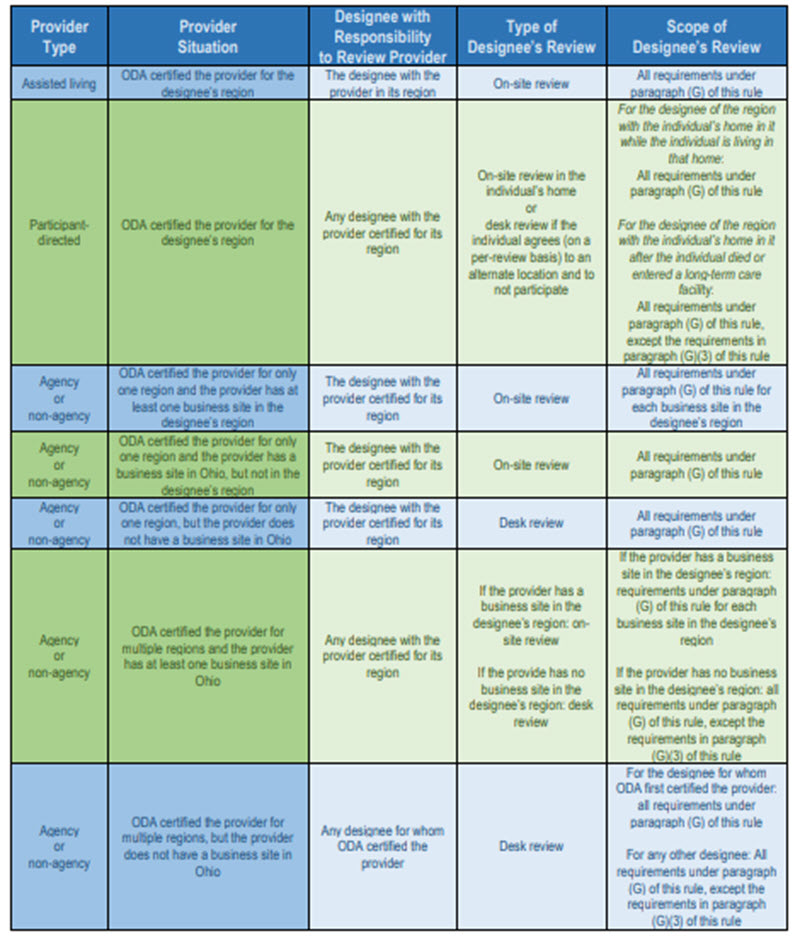
Appendix B
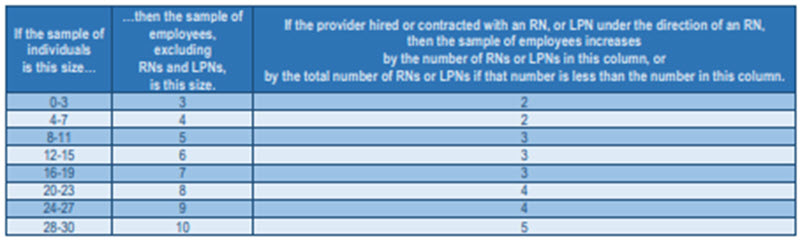
173-39-05 ODA provider certification: disciplinary actions.
(A) Introduction: Pursuant to section 173.391 of the Revised Code, ODA or its designee may impose disciplinary action against an ODA-certified provider (provider) for good cause, including misfeasance, malfeasance, nonfeasance, confirmed abuse or neglect, financial irresponsibility, or other conduct ODA determines is injurious, or poses a threat, to the health or safety of individuals being served.
(B) Disciplinary actions by ODA's designee:
(1) Disciplinary actions imposed by ODA's designee may include any one or more of the following:
(a) Plan of correction or evidence of compliance: ODA's designee may require the provider to provide a plan of correction or evidence of compliance with all areas of non-compliance within seven
seven business days after the disciplinary action is imposed.
(b) Evidence of compliance: ODA's designee may require the provider to provide evidence of compliance according to the following deadlines:
(i) Health or safety: If the non-compliance is injurious or poses a threat to the health or safety of individuals being served, the provider shall provide evidence of compliance within five days after the disciplinary action is imposed.
(ii) Non health or safety: If the non-compliance is not injurious or poses no threat to the health or safety of individuals being served, the provider shall provide evidence of compliance within sixty days after the disciplinary action is imposed.
(c)
(b) Suspending referrals: ODA's designee may cease to refer individuals to the provider until ODA's designee determines the provider complies with all requirements in this chapter.
(c) Remove clients: ODA's designee may revise the person-centered services plans for individuals to stop authorizing the non-compliant provider as a provider for those individuals.
(2) When ODA's designee imposes a disciplinary action, it shall do the following:
(a) Notify the provider of the disciplinary action via encrypted email or mail.
(b) Notify ODA of the disciplinary action via an ODA-approved method.
(c) Complete the required fields in ODA's provider information management system
PIMS related to the disciplinary action.
(d) Indicate in ODA's provider information management system
PIMS anytime it grants an extension to the deadlines in paragraph (B)(1)(a) or (B)(1) (b) of this rule.
(3) ODA's designee does not have authority to impose more than one disciplinary action against a provider for the same episode of non-compliance.
(4) ODA's designee may follow-up with the provider to verify compliance in the area of non-compliance. Follow-up may include site visits, requesting supplemental information, or reviewing records.
(4)
(5) ODA may require ODA's designee to rescind or modify any pending disciplinary action.
(C) Disciplinary actions imposed by ODA:
(1) ODA may impose any discipline authorized in
under division (A)(2) of section 173.391 of the Revised Code, including the following:
.
(a) Plan of correction.
(b) Evidence of compliance.
(c) Suspension of referrals.
(d) Removal of clients.
(e) Fiscal sanctions, including a civil monetary penalty or an order that unearned funds be repaid.
(f) Suspension of certification.
(g) Permanent revocation of certification.
(h) Another disciplinary action.
(2) ODA may consider any one or more of the following when imposing disciplinary action:
(a) Whether the conduct is injurious or poses a threat to the health or safety of individuals being served.
(b) The provider's previous disciplinary history.
(c) Any other factors ODA may consider relevant.
(D) A provider may appeal a disciplinary action listed in column B of table 1 to this rule unless the reason for the disciplinary action is listed under division (E) of section 173.391 of the Revised Code. As used in table 1 to this rule, "another sanction" does not include any of the disciplinary actions listed in column A of the table.
Table 1
| COLUMN A | COLUMN B |
| Written warning | Fiscal sanction such as a civil monetary penalty or an order to repay unearned funds |
| Requirement to submit a plan of correction or provide evidence of compliance | Suspended certification |
| Suspended referrals | Revoked certification |
| Removal of clients | Another sanction |
(E) The provider may request a hearing under Chapter 119. of the Revised Code only if it does so within thirty days after the mailing date of the notice
before the deadline in that chapter.
(F) If any deadline in this rule occurs on a Saturday, Sunday, or legal holiday under section 1.14 of the Revised Code, the deadline is extended to the next day that is not a Saturday, Sunday, or legal holiday under section 1.14 of the Revised Code.
Effective:
Five Year Review (FYR) Dates: 3/26/2024
_____________________
Certification
_____________________
Date
Promulgated Under: 119.03
Statutory Authority: 121.07, 173.01, 173.02, 173.391, 173.52, 173.522, 173.54, 173.543
Rule Amplifies: 173.39, 173.391, 173.52, 173.522, 173.54, 173.543; 42 C.F.R. 441.352
Prior Effective Dates: 03/31/2006, 08/30/2010, 06/30/2011, 09/29/2011, 01/01/2013, 01/01/2020, 07/02/2023